Vapi, Retell or a Managed Open Stack? A Voice AI Platform Comparison
Any voice AI platform comparison comes down to two questions: how freely can you swap the parts, and who builds and maintains the agent? See where Vapi, Retell, Bland, Synthflow and a managed open stack fit.
Lina Belmeddah leads marketing for Vatel at Devpro in Montreal: brand, content, and go-to-market for enterprise AI voice agents. She turns real deployments into case studies and product narrative buyers can act on.
Shopping for a voice AI platform? Any voice AI platform comparison comes down to two questions. How freely can you swap the parts, and who builds and maintains the agent?
- All-in-one platforms bundle everything together, from the phone connection and speech-to-text to the AI and the voice. The vendor picks and connects every part for you.
- Open stacks take a different approach. They let you mix parts from different providers and replace them as your needs change.
Let's break down both.
What is an all-in-one voice AI platform?
With an all-in-one platform, you set up the agent in the vendor's own interface, and the vendor decides which technology sits behind each part.
The benefit is speed and simplicity. The trade-off is that you live with the vendor's choices. If its speech-to-text struggles with Quebec French, or a better model comes out elsewhere, you wait for the vendor to change it, or you don't get it at all.
What is an open voice AI stack?
An open stack, also known as a modular stack, lets you combine parts from different providers instead of relying on a single vendor. An orchestration layer connects everything and coordinates speech-to-text, the AI model and text-to-speech in real time. To see how these parts work together on a call, read how voice AI works.
The key advantage is flexibility. You can replace one part without rebuilding the whole agent.
How much of that flexibility you manage yourself depends on the type of open stack. With a managed open stack, the provider picks, connects, tests and maintains the parts for you. With a developer open stack, you get the tools, but your engineers build and run the agent. Open-source frameworks go one step further. The code is free, but all the engineering work stays with your team.
How do you tell voice AI platforms apart?
Every option so far answers the same two questions in its own way. Can you swap the parts, or are they locked to one vendor? Who builds and maintains the agent, your team or the provider? Put those two questions on a chart, and every voice AI platform lands in one of four boxes.
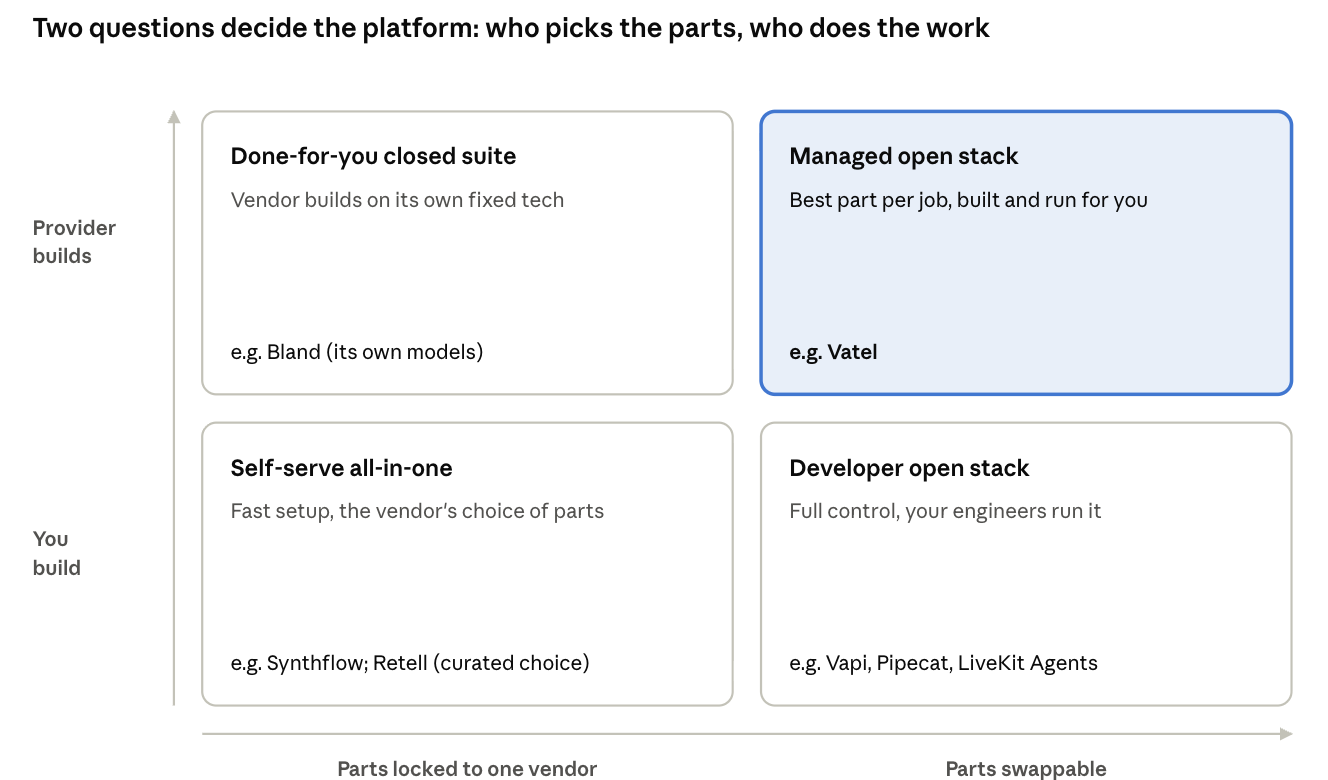
Most comparisons only look at the horizontal axis. For a business without an in-house AI team, the vertical axis matters just as much. An open stack you have to run yourself can cost more in engineering time than it saves.
Where well-known platforms fit
Here's where some well-known names sit, based on how each one describes itself as of October 2026.
- Vapi describes itself as an orchestration layer that connects your choice of speech-to-text, language model and voice providers. It is built for developers (Vapi, Cekura).
- Retell AI offers APIs for developers and a no-code drag-and-drop builder, with one-time setup help from its engineers (Retell).
- Bland AI runs its own speech-to-text, language model and voice, and its engineers build each client's first agent (Bland).
- Synthflow is an enterprise platform with a visual flow designer and engineers who help launch agents (Synthflow).
- Pipecat and LiveKit Agents are open-source frameworks that engineering teams use to build custom voice agents (WebRTC.ventures).
- Vatel is a managed open stack. Its team picks, connects and maintains the parts for each client, with an all-Canada setup available for clients who need it. It connects to several providers at each layer, such as Deepgram, AssemblyAI and Speechmatics for speech-to-text, Google and Anthropic for the AI model, and ElevenLabs or Cartesia for the voice.
Voice AI platform comparison, side by side
Once you know which box you're in, the trade-offs are easy to see. All-in-one platforms are the fastest to launch. Open stacks give you more control over quality, language and data. A managed open stack keeps that control without needing developers on your side. Closed suites like Bland sit apart, since the vendor controls both the parts and the work.
| Criterion | Self-serve all-in-one | Developer open stack | Managed open stack |
|---|---|---|---|
| Time to a first agent | Fastest | Depends on your engineers | Built for you by the provider |
| Swap each part | No, or from a short list | Yes | Yes, done by the provider |
| Quality in Quebec French | Depends on the vendor's default parts | You pick the best part per language | The provider picks the best part per language |
| Where data is processed | On the vendor's infrastructure and partners | Wherever you deploy, with the providers you choose | Depends on the provider (Vatel: US and EU by default, all-Canada setup on request) |
| Who maintains it | Vendor runs the platform, you maintain your flows | Your engineers | The provider |
When an all-in-one platform makes sense
An all-in-one platform is the right call when the job is narrow and the stakes are low. It usually fits cases like these.
- One simple use case, like answering FAQs or taking messages after hours
- English-only callers
- A quick test to see whether callers accept an AI agent
- Low call volume, where per-minute pricing stays small
- No strict rules on where call data can be processed
The risk shows up later. Many teams start with a quick test, then hit the platform's limits once they add a second use case or a second language, after their flows are already built in the vendor's format.
When an open stack makes sense
An open stack is the better fit as soon as the agent becomes part of how the business runs. It usually fits cases like these.
- Several use cases on the same line, like booking, support and qualification
- French and English callers. Performance in one language says little about another, so you want the best part for each
- Rules on where data goes, such as Quebec's Law 25 or client contracts
- Connections to your phone system, CRM and calendar
- Growing volume, where paying each provider directly beats a margin on every minute
What an open stack needs to work in production
Swapping parts is only useful if you can tell whether the new part is better, and if the agent keeps working when a part fails. A production-ready open stack has four things in place.
- A way to test every change. A fixed set of test calls and one main measure of success, such as tasks completed, so a new model can be judged in days, not weeks.
- Backup providers. A second option at each layer that takes over if the first one slows down or fails.
- A graceful fallback. When something breaks, the agent says “Sorry, could you repeat that?” instead of going silent or hanging up.
- Specialized agents instead of one giant instruction set. One agent per task (greeting, booking, support) with clear handoffs, each using the model that suits its job. A single agent with every rule crammed into one prompt tends to lose focus as it grows.
With a developer open stack, your team builds these. With a managed open stack, the provider does. At Vatel, every change is tested in a voice simulator, against edge cases, accents and interruptions, before it goes live.
How to pick each part is covered in choosing STT, TTS and LLMs, and the full build-or-buy decision in build vs. buy vs. modular.
Questions to ask before you sign
These eight questions show quickly which box a provider really sits in, whatever its website says.
- Which parts can we change, and how long does a change take?
- Who tests a new model before it reaches our callers?
- Which providers process our call data, and in which countries?
- How good is the agent in Quebec French? Can we hear a real call?
- What happens when one provider goes down?
- Can we use different models for different tasks or languages?
- If we leave, do we keep our call flows, recordings and data?
- What does the bill look like at ten times our current volume?
Want to see how a managed open stack answers them for your use case? Book a demo
FAQ
What is a voice AI stack?
A voice AI stack is the set of technologies behind a voice agent. That's the phone connection, speech-to-text, the language model, text-to-speech and the orchestration layer that coordinates them in real time.
Is an open stack harder to manage?
Only if you run it yourself. A developer open stack needs engineers to build, test and maintain it. A managed open stack gives you the same flexibility with the provider doing that work.
Can I start on an all-in-one platform and switch later?
Yes, but expect to rebuild your call flows, since they live in the vendor's format. Ask about exporting flows, recordings and data before you sign.
Is Vapi an open stack or an all-in-one platform?
Vapi is an open stack for developers. It lets engineering teams connect the speech-to-text, model and voice providers of their choice, then build and run the agent themselves.
Is open source voice AI free?
The frameworks are free to use. The speech, model and voice providers, the hosting and the engineering time are not, so the total cost is often higher than it looks.
Does my phone system's built-in AI count as all-in-one?
Yes. AI features built into a phone system are all-in-one by design. They're convenient for the basics but limited for custom workflows and model choice.